


Preloader
img

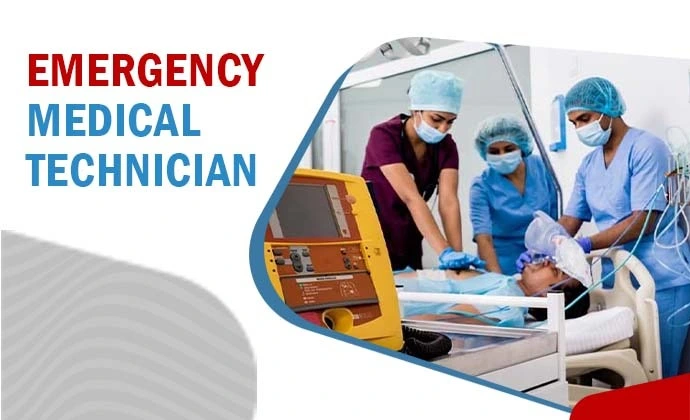
Emergency Medical Technician Course

Course Description

CORE JOB ROLES : Emergency Medical Technician - Basic – HSS/Q2301

ELIGIBLE QUALIFICATION :  12th pass

CERTIFICATION : SSC Certificate

APPRENTICESHIP (OJT) : 450 hrs

HORIZONTAL ENABLER : AI- enabled diagnostics and digital tools like Digital Health Records, microscopy system, GPS Ambulance Systems, Oprating cloud -PACS viewers, descision-support alerts

Basic Emergency Response and Clinical Skills for Handling Medical, Trauma, Mass Casualty, and Disaster Situations; Emergency Call Response and Scene Safety Management; Ambulance Setup and Emergency Support Systems; Infection Control Practices; Safe Patient Transfer, Mobility, and Ambulation Techniques; Personal Hygiene and Patient Care Assistance; Response to Medical and Facility Emergencies; Professional Behaviour and Work Ethics in Healthcare; and Effective Communication Skills for Patient Care and Emergency Support.

LAB SET UP NEED  : 3D models of human body and accessory organs, model human skeletal system, BP Apparatus (Manual / Automatic),Pulse Oximeter,Concentrator,Spirometer,steam -inhaler, Thermometer,Stethoscope,Glucometer,Spine Board with Straps,Cervical Collars (Small, Medium, Large),Scoop Stretcher / Wheelchair,CPR Manikin (Adult),Ambu Bag with Mask (Adult),Automated External Defibrillator(AED,Oropharyngeal Airways (Assorted Sizes),Nasopharyngeal Airways,Oxygen Cylinder with Flow Meter & Regulator,Nebulizer with Mask,Suction Machine with Catheters,Laryngoscope with Blades,Endotracheal Tubes (Assorted Sizes),IV Cannulas & IV Sets(Macrodrip/Microdrip),Basic IV Fluids (NS / RL),Syringes (5 ml, 10 ml),Bandages & Crepe Bandages,Splints (Malleable),Cardiac Monitor

TYPE OF EMPLOYERS : Hospitals, emergency medical services, Ambulence services

Course Curriculum

course FAQ

An Emergency Medical Technician (EMT) course prepares learners to provide basic emergency and pre-hospital care to patients before and during transportation to a healthcare facility. The training covers emergency response, patient assessment, trauma care, infection control, ambulance operations, patient transportation, communication and documentation.

The EMT-Basic curriculum allows candidates who have completed Class 12, are pursuing the first year of an undergraduate programme, or meet specified diploma/previous qualification and experience pathways to enrol.

The standard entry route is Class 12 pass. The curriculum also provides alternative eligibility routes for candidates pursuing or holding specified diploma or relevant NSQF qualifications.

The EMT-Basic programme has a total duration of 450 hours, including 240 hours of classroom and skill-lab training, 150 hours of OJT/internship/clinical or laboratory training, and 60 hours of employability skills.

Learners develop practical skills in emergency response, patient assessment, trauma care, infection control, safe patient transfer, ambulance operations, communication, documentation, emergency procedures and handling different emergency scenarios. The programme also develops professional behaviour and communication skills.

Yes. The curriculum specifically includes 150 hours of OJT/internship/clinical or laboratory training, in addition to classroom and skill-lab training.

The training prepares learners for opportunities in emergency medical services, ambulance services, hospitals and other pre-hospital healthcare settings, depending on employer requirements and applicable regulations.

EMT can be a suitable career pathway for individuals interested in emergency healthcare, patient support and pre-hospital care. The role combines practical healthcare skills with emergency response and can provide opportunities within the wider allied healthcare workforce.

Salary varies depending on location, employer, experience, qualification, work setting and responsibilities. The attached curriculum does not prescribe a specific salary figure, so candidates should check current employer-specific salary ranges rather than relying on a fixed number.

Yes. EMT training is specifically designed around pre-hospital emergency care and ambulance operations, while the skills are also relevant to emergency and patient-support environments within healthcare facilities. The curriculum includes ambulance operations, patient movement, emergency response and patient reporting.

A prior medical qualification is not necessarily required when the candidate meets the prescribed entry criteria. The programme is designed to progressively develop the healthcare knowledge and practical skills required for the EMT-Basic role.

An EMT primarily focuses on emergency and pre-hospital care, including emergency response, patient assessment, trauma management and ambulance operations. A General Duty Assistant (GDA) focuses more on basic patient care and support within healthcare settings, such as bathing, grooming, nutrition, mobility, bed making, infection control and routine patient activities.

Yes. The programme is structured as vocational training and can be suitable for eligible beginners who are interested in developing job-ready skills in emergency healthcare and pre-hospital care.

Certification depends on the applicable assessment and certification process for the programme. Candidates should confirm the specific certification arrangements with Peerless Skills Academy before enrolment.

The programme is designed around competency-based learning, practical skill development and employability, with training covering emergency response, patient care, ambulance operations, communication and workplace skills. The curriculum also includes substantial practical and OJT exposure.
img

PSA Instructor

Developer

I am a web developer with a vast array of knowledge in many different front end and back end languages, responsive frameworks, databases, and best code practices

Reviews

0.0
0 Ratings
5
0
4
0
3
0
2
0
1
0
Course includes:
  • img Level
      Beginner Intermediate Expert
  • img Duration 300h
  • img Certifications Yes
  • img Language
      English Hindi
  • img Course Type
Share this course: